

The question most homeowners ask is which one they need. The honest answer is that a French drain and a sump pump are not competing solutions. They solve different parts of the same problem, and most effective basement waterproofing systems use both together.
That said, there are situations where one addresses the problem without the other. Understanding what each system actually does is the starting point for knowing what your basement needs.
If you are in Southeastern Michigan and want a professional assessment of your drainage situation, Sump Pump Installation in SE Michigan covers the full scope from inspection through installation.
What a French Drain Does
A French drain is a passive drainage system. It has no moving parts, no electricity, and nothing to fail mechanically.
The basic design is a perforated pipe set in a gravel-filled trench. Water migrates through the gravel, enters the pipe through perforations, and flows by gravity to wherever the pipe discharges.
In a basement context, an interior French drain runs along the perimeter of the basement floor, typically set into a channel cut at the base of the foundation wall. Water that seeps in through wall cracks, the cove joint, or up through floor pressure is intercepted by the drain before it spreads across the floor.
The key word is intercepted. A French drain collects water and moves it somewhere. It does not remove it from the property on its own unless the discharge point is downhill and allows gravity to carry it there.
What a French drain is good for:
- Intercepting water entering through the wall-floor joint
- Relieving hydrostatic pressure building along the basement perimeter
- Channeling seepage from multiple entry points to a single collection point
- Managing surface water around the foundation exterior
What a French drain cannot do:
- Remove water that has nowhere lower to go
- Handle active flooding from a high water table without a pump assisting
- Work in heavy clay soil where water cannot percolate effectively without modifications
What a Sump Pump Does
A sump pump is an active system. It sits in a pit dug into the basement floor, detects when water reaches a set level, and pumps it out through a discharge line that exits the home.
It has one job: remove water that has collected in the pit and get it away from the foundation.
On its own, a sump pump depends on water reaching the pit somehow, whether through floor seepage, wall entry, or a connected drainage system feeding into it. A pump sitting in an isolated pit with no drainage feeding it only captures water that pools directly at the lowest point of the floor.
What a sump pump is good for:
- Removing water from a basement once it has collected
- Managing a high water table that pushes water up through the floor slab
- Handling active flooding from storm events
- Providing immediate water removal that a passive drain cannot do
What a sump pump cannot do:
- Intercept water entering along the full basement perimeter
- Relieve hydrostatic pressure building against the foundation walls
- Operate without power unless a battery backup is installed
The Core Difference
The simplest version of this comparison is this: a French drain moves water, a sump pump removes it.
They are designed to work in sequence. The French drain collects water from the perimeter and channels it toward the sump pit. The sump pump ejects that collected water out of the home and away from the foundation.
Neither is complete without the other in most real-world basement moisture situations.
French Drain vs Sump Pump: Side by Side
| Feature | French Drain | Sump Pump |
| Function | Collects and redirects water | Removes collected water |
| Power required | No | Yes |
| Moving parts | None | Motor, float switch, impeller |
| Best for | Perimeter seepage, pressure relief | Active flooding, high water table |
| Maintenance | Occasional flushing, inspect for silt | Annual inspection, test float switch |
| Failure risk | Clogging over years | Power outage, mechanical failure |
| Works alone | Only with gravity discharge available | Only when water reaches the pit naturally |
When a Sump Pump Alone Is Enough
A sump pump without a French drain works in one specific scenario: water is collecting at the lowest point of the basement floor and just needs to be lifted out, and there is no significant perimeter seepage entering along the walls.
This typically applies to homes where:
- The primary issue is a rising water table pushing water up through a single area of the floor
- The basement is relatively dry except during severe storms
- There are no wall cracks or cove joint seepage contributing to the problem
In Southeastern Michigan, spring thaw and heavy summer storms regularly raise the water table quickly. A properly sized sump pump with battery backup handles these events when the water intrusion is floor-based rather than perimeter-based.
When a French Drain Alone Is Enough
An exterior French drain without a pump works when there is a natural gravity outlet, meaning the discharge point is lower than the drain and water can flow there on its own without being pumped.
This is most applicable to:
- Surface water management around the foundation exterior
- Homes on sloped lots where water naturally drains away downhill
- Situations where the problem is surface runoff reaching the foundation rather than groundwater pressure
An interior French drain alone almost never works without a pump in a Michigan basement, because there is typically no gravity outlet that allows water to exit the home without being pumped upward.
When You Need Both
Most wet basement situations call for both systems working together. The scenarios that consistently require the combined approach:
Chronic perimeter seepage. Water enters along the wall-floor joint, the cove joint, or through multiple wall cracks around the basement perimeter. A sump pump alone cannot intercept this water before it spreads. The French drain captures it at the source and routes it to the pit. The pump removes it from the home.
High water table combined with wall seepage. Both floor pressure and wall entry are contributing. The French drain handles the perimeter. The pump handles the floor pressure and removes everything the drain collects.
Finished or partially finished basements. Any basement with flooring or finished walls needs water intercepted before it reaches those surfaces. An interior French drain running beneath the perimeter floor catches water before it surfaces. A pump removes it silently.
Clay soil conditions. Southeastern Michigan’s heavy clay soil retains water and transmits it slowly. Clay does not drain passively the way sandy soil does. Water builds pressure against foundation walls rather than dispersing, which means both pressure relief through interior drainage and active water removal through a pump are necessary.
A French Drain in the Basement With a Sump Pump: How the System Works Together
In a standard interior waterproofing installation, the two systems are physically connected.
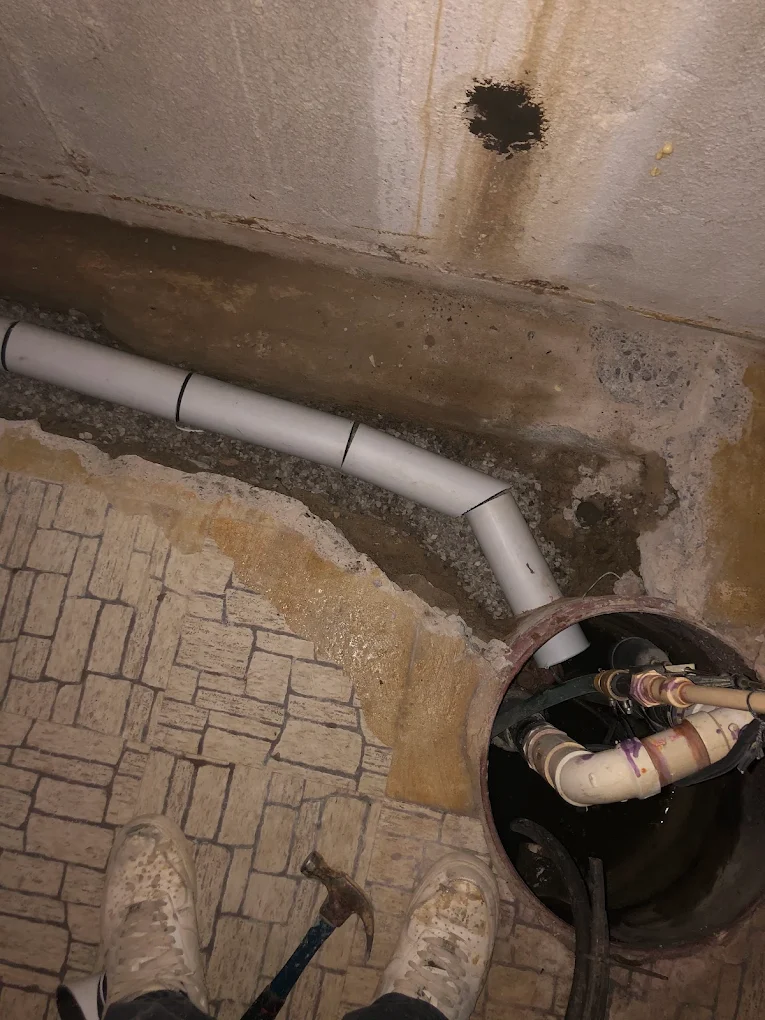
A channel is cut around the interior perimeter of the basement floor at the base of the foundation wall. A perforated drain pipe is set into the channel with gravel backfill and covered with concrete. That pipe runs continuously around the perimeter and connects to the sump pit at a low point in the floor.
Water entering through the walls or cove joint drops into the channel, flows through the perforated pipe by gravity, and collects in the sump pit. The pump activates when the pit reaches the float trigger level, ejecting water through a discharge line to a point outside the home and away from the foundation.
The result is a system that intercepts water at the entry point, moves it without spreading it across the floor, and removes it from the home automatically.
Maintenance Requirements for Each System
French drain maintenance:
- Inspect annually for silt or root intrusion that can reduce flow capacity
- Flush the drain line periodically if flow appears reduced
- Check that the gravel bed has not compacted significantly over time
- Interior French drains require less maintenance than exterior ones because they are not exposed to soil root growth in the same way
Sump pump maintenance:
- Test the float switch by pouring water into the pit and confirming the pump activates
- Check the discharge line for obstructions, particularly at the exterior outlet
- Inspect the check valve on the discharge line to confirm it is preventing backflow
- Test the battery backup annually and replace the battery every 3 to 5 years
- Clean the pit of any accumulated debris that could clog the intake
The Southeastern Michigan Factor
Southeastern Michigan presents specific conditions that affect this decision more than geography alone.
The clay-heavy soil throughout the region holds moisture and builds hydrostatic pressure against foundation walls at a rate that sandy or loamy soil does not. Freeze-thaw cycles through winter and early spring crack foundation walls and expand existing cracks, creating new seepage points every year.
Spring thaw is the hardest test. Snow melting rapidly over frozen ground has nowhere to go. It saturates the soil surrounding the foundation and raises the water table quickly. A system that handles a dry summer may completely fail its first wet spring if it was undersized or incomplete.
The combination of interior French drain and properly sized sump pump with battery backup is the standard solution for Southeastern Michigan basements specifically because it addresses both the perimeter seepage that clay soil drives and the water table rise that spring thaw creates.
Conclusion
A French drain and a sump pump are not the same thing and neither one fully replaces the other.
A French drain collects and channels. A sump pump collects and removes. For most Southeastern Michigan basements dealing with chronic moisture, both systems installed together is the complete answer, not a choice between them.
If you are dealing with standing water, perimeter seepage, or a basement that gets wet every spring, the next step is a professional assessment that looks at where the water is entering and what combination of drainage and removal will actually keep it out permanently.
FAQs
Is a French drain better than a sump pump?
They are not interchangeable. A French drain collects and redirects water. A sump pump removes collected water from the home. Neither does the full job the other does. In most wet basement situations, both systems work together in sequence, with the French drain channeling water to the sump pit and the pump ejecting it out of the home.
Can a French drain replace a sump pump?
Only if there is a natural gravity outlet lower than the drain that allows water to flow out of the home without being pumped. In most basements, including the majority of homes in Southeastern Michigan, no such outlet exists. Water collected by the French drain has to go somewhere, and without a pump, it has nowhere to go.
Do I need both a French drain and a sump pump?
For chronic perimeter seepage, high water table conditions, or any basement where water enters along the walls and wall-floor joint, yes. The French drain handles interception and routing. The pump handles removal. Running only one system leaves a gap that the other fills.
What is a French drain in a basement with a sump pump?
It is an interior perimeter drainage system where a perforated pipe runs along the base of the foundation wall, collects incoming water, and feeds it into the sump pit. The sump pump then activates and removes the water from the home through a discharge line. This combined system is the standard professional waterproofing installation for basement moisture problems.
How does Southeastern Michigan clay soil affect this decision?
Clay soil retains moisture and transmits it slowly, building hydrostatic pressure against foundation walls rather than dispersing. It does not drain passively the way sandy soil does. Combined with seasonal freeze-thaw cycles that crack concrete and spring thaw that raises the water table rapidly, Michigan basements need both pressure relief through interior drainage and active water removal through a sump pump more consistently than basements in regions with better-draining soil.
What happens to the sump pump if the power goes out?
A standard sump pump stops operating without power. Power outages during heavy storms are exactly when the pump is most needed. A battery backup sump pump activates automatically when the primary pump loses power and handles moderate water volume for several hours. Installing battery backup as part of the system is strongly recommended in Southeastern Michigan where summer storm outages are common.
How long does an interior French drain last?
An interior French drain system installed with proper gravel bed and perforated pipe lasts 20 to 30 years or more with minimal maintenance. The primary long-term concern is silt accumulation in the pipe that gradually reduces flow capacity. Annual inspection and periodic flushing of the line keeps the system functioning at full capacity throughout its service life.
