

Most basements have poor air circulation by default. They sit below grade, surrounded by soil on three or more sides, with limited openings for fresh air to enter or stale air to exit. That lack of airflow creates conditions where moisture accumulates, odors linger, and air quality drops well below what the rest of the house maintains.
Ventilating a basement properly means creating a system that moves fresh air in, pushes stale air out, and controls humidity in the process. The right approach depends on whether the space has windows, how the basement is used, and whether moisture is already a problem or you’re trying to prevent one.
If you’re in the Metro Detroit area, the team at Bdry system can evaluate your basement’s current airflow and moisture conditions and recommend the ventilation approach that fits your situation.
Do Basements Need Ventilation?
Yes. Every basement needs some form of ventilation, whether it’s a finished living space, a storage area, or an unfinished utility room.
Basements are naturally prone to higher humidity than the floors above them. Cool foundation walls cause warm, moist air to condense on contact. Soil moisture migrates through concrete block and poured walls even when no visible water intrusion exists. That constant low-level moisture, combined with minimal air movement, creates the exact conditions where mold, mildew, and musty odors thrive.
Beyond moisture, basements also trap gases that can pose health risks. Radon, a naturally occurring radioactive gas, enters basements through cracks in the slab and foundation walls and accumulates in poorly ventilated spaces. The EPA estimates that radon is responsible for roughly 21,000 lung cancer deaths per year in the United States, and basement ventilation is one of the most effective ways to reduce indoor radon concentrations.
Carbon dioxide, volatile organic compounds (VOCs) from stored chemicals and building materials, and off-gassing from furnaces and water heaters also concentrate in basements without adequate air exchange. Proper ventilation dilutes these contaminants and replaces them with fresher air from outside or from the conditioned space above.
A basement that smells musty, feels damp, or shows condensation on walls and pipes is telling you it needs better airflow. Ignoring that signal leads to mold growth, wood rot in floor joists, and deteriorating indoor air quality throughout the entire home, since research consistently shows that 40 to 50 percent of the air on a home’s first floor originates from below.
How to Ventilate a Basement Without Windows
Windowless basements are the most common and the most challenging to ventilate. Without natural openings, you need mechanical solutions to create the air exchange that windows would otherwise provide.
Exhaust Fan Installation
An exhaust fan mounted through an exterior wall or connected to a duct that terminates outside is the simplest mechanical ventilation option for a windowless basement. The fan pulls stale, humid air out of the basement, and replacement air enters through gaps around doors, ducts, and other passive pathways.
A bathroom-style exhaust fan rated at 50 to 80 CFM (cubic feet per minute) handles a small to mid-sized basement. Larger spaces or basements with persistent moisture issues benefit from a fan rated at 100 to 150 CFM or higher. Timer switches or humidity-sensing controls allow the fan to run only when needed rather than continuously.
The key is venting the fan directly to the outside, not into an attic, crawl space, or another interior area. Exhausting moist basement air into an attic creates condensation problems there instead of solving them in the basement.
Supply Fan or Balanced Ventilation
Instead of only pulling air out, a supply fan pushes fresh outdoor air into the basement while stale air exits through other pathways. This approach creates slight positive pressure in the basement, which can also help reduce radon infiltration by resisting the natural negative pressure that draws soil gases through foundation cracks.
A balanced system uses both a supply fan and an exhaust fan, providing controlled airflow in both directions. Energy recovery ventilators (ERVs) and heat recovery ventilators (HRVs) are balanced systems that transfer heat and (in the case of ERVs) moisture between the incoming and outgoing air streams, reducing the energy cost of conditioning the fresh air.
ERVs and HRVs cost $1,000 to $3,000 installed but pay for themselves over time through reduced heating and cooling costs. They’re the gold standard for basement ventilation in climates with extreme temperatures, where bringing in unconditioned outdoor air creates its own problems.
Ductwork Tie-In to HVAC System
If the home’s HVAC system has supply and return ducts running to the basement, keeping the system fan on “circulate” mode (or running it on a timer) provides consistent air exchange between the basement and the rest of the house. This doesn’t bring fresh outdoor air in, but it prevents the basement from sitting in its own stagnant air pocket all day.
Adding a return air duct to the basement if one doesn’t already exist allows the HVAC system to pull basement air into the central system, filter it, and redistribute it. This is often the most cost-effective improvement for finished basements that already have supply ducts but lack a return path.
How to Vent a Basement Bathroom
Basement bathrooms have specific ventilation requirements that go beyond general basement airflow. The combination of shower steam, toilet moisture, and intermittent use in an already humid environment makes proper venting essential.
Code Requirements
Most building codes require a basement bathroom to have either a window that opens or a mechanical exhaust fan that vents directly to the outside. Since most basement bathrooms don’t have windows, the exhaust fan is the standard solution.
The International Residential Code (IRC) requires a minimum exhaust rate of 50 CFM for a bathroom. For basement bathrooms, going higher (70 to 110 CFM) is worth the marginal cost increase because the starting humidity level in a basement is already elevated compared to an above-grade bathroom.
How Do You Vent a Basement Bathroom
The exhaust fan must vent to the exterior of the home, not into the basement space, the attic, or a wall cavity. There are two common paths for the vent duct:
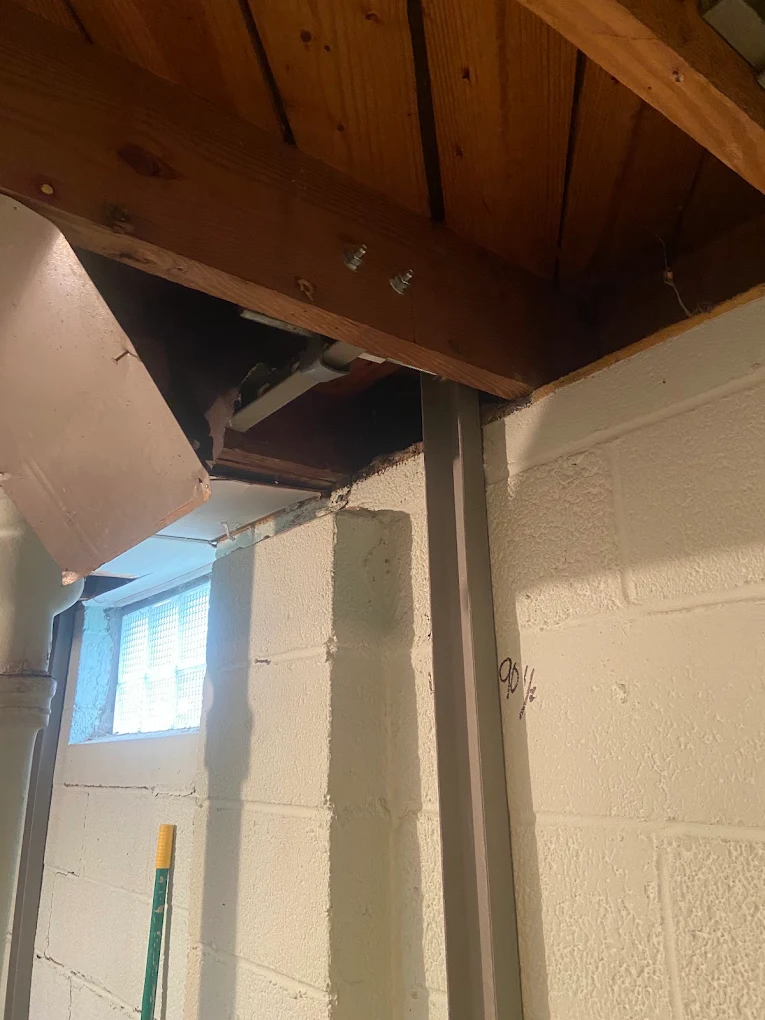
Through the rim joist. The rim joist sits at the top of the foundation wall where the floor framing meets the sill plate. Running the vent duct from the fan straight to the rim joist and through to the outside is typically the shortest, most direct path. A short duct run means less air resistance and better fan performance.
Up through the floor and out through the roof or sidewall. When the bathroom is positioned far from an exterior wall, the duct may need to run vertically through the floor above and tie into the home’s existing vent stack or exit through the roof. Longer duct runs reduce fan efficiency, so upsize the fan by 1 CFM for every additional foot of duct beyond the manufacturer’s rated length.
Use rigid or semi-rigid metal duct rather than flexible vinyl. Metal duct has less air resistance, doesn’t sag over time, and meets code in most jurisdictions. All joints should be sealed with foil tape (not standard duct tape, which deteriorates in humid conditions) and the duct should slope slightly downward toward the exterior termination point so condensation drains out rather than pooling inside the duct.
Install a vent cover with a damper on the exterior termination to prevent backdrafts, pest entry, and cold air infiltration when the fan isn’t running.
Humidity Control After Venting
Even with a properly vented exhaust fan, a basement bathroom benefits from a dehumidifier if the surrounding basement space runs above 55% relative humidity. The exhaust fan handles peak moisture events (showers), but a dehumidifier manages the baseline humidity that accumulates between uses.
How to Improve Air Quality in Basement
Ventilation is the foundation of basement air quality, but it’s not the only factor. Several additional measures work alongside airflow to bring basement air quality closer to what the rest of the house maintains.
Control Moisture at the Source
No amount of ventilation fixes a basement with active water intrusion. If water is coming through walls, the floor, or around pipe penetrations, that problem needs to be solved before ventilation improvements will have any lasting effect.
Waterproofing the foundation walls, installing or maintaining a sump pump, correcting exterior grading, and extending downspouts away from the foundation all reduce the moisture load that your ventilation system has to handle. Services like Basement Waterproofing in Metro Detroit address these root causes so that ventilation and dehumidification can work the way they’re designed to.
Run a Dehumidifier
A standalone dehumidifier rated for the square footage of your basement keeps relative humidity between 30 and 50 percent, the range recommended by the EPA for healthy indoor air. Units with built-in humidistats cycle on and off automatically to maintain the target level.
For basements under 1,500 square feet, a 50-pint unit handles most conditions. Larger or particularly damp basements may need a 70-pint commercial-grade unit with a continuous drain line routed to a floor drain or sump pit, eliminating the need to empty a collection bucket manually.
Use Air Filtration
A standalone HEPA air purifier captures mold spores, dust, pet dander, and other particulates that accumulate in basement air. This is especially valuable in finished basements used as living spaces, home offices, or bedrooms.
If the basement is connected to the central HVAC system, upgrading the furnace filter to MERV 11 or higher improves filtration for the entire home, including the air circulating through the basement.
Eliminate Stored Chemical Sources
Paint cans, solvents, adhesives, gasoline containers, and cleaning products stored in the basement release VOCs that ventilation alone may not fully clear. Moving chemical storage to a detached garage or outdoor shed, or sealing containers tightly, reduces the VOC load in the basement air.
Address Radon
If radon testing indicates levels at or above 4.0 pCi/L (the EPA’s action level), a radon mitigation system should be installed alongside any general ventilation improvements. Active soil depressurization, the most common mitigation method, uses a fan and sealed pipe to pull radon from beneath the slab and exhaust it above the roofline before it enters the basement.
Radon mitigation typically costs $800 to $1,500 installed and reduces indoor radon levels by up to 99 percent. It operates independently of the basement’s general ventilation system.
How to Ventilate a Cellar
Older cellars present unique ventilation challenges. They tend to have lower ceiling heights, stone or rubble foundations without vapor barriers, dirt or deteriorating concrete floors, and minimal (if any) electrical service.
The principles are the same as any basement: move stale air out, bring fresh air in, and manage moisture. The methods need to account for the limitations of the space.
Passive Ventilation for Cellars
Many older cellars have small windows, vents, or hatchways that can provide passive ventilation when opened. Cross-ventilation, where air enters from one side and exits from another, works when at least two openings exist on opposite or adjacent walls.
Passive ventilation has limits. It depends entirely on outdoor conditions. On still, humid days, passive airflow may be negligible. During winter, open vents lose heat and can cause pipes to freeze. Passive ventilation works best as a supplement to mechanical methods, not as the sole solution.
Mechanical Options for Cellars
A small exhaust fan wired to a humidity sensor is the minimum effective mechanical ventilation for a cellar. The sensor triggers the fan when humidity exceeds a set threshold (55 to 60 percent is typical) and shuts it off when levels drop, providing automated moisture control without running the fan continuously.
For cellars used to store wine, food, or moisture-sensitive items, a small portable dehumidifier paired with the exhaust fan maintains stable conditions year-round. Monitor temperature alongside humidity, since dehumidifiers generate heat and can raise cellar temperatures in a small, enclosed space.
Vapor Barrier and Drainage Considerations
In cellars with dirt floors, installing a 6-mil or thicker polyethylene vapor barrier across the floor dramatically reduces ground moisture entering the space. This single improvement often does more for cellar air quality than any fan or dehumidifier because it addresses the largest moisture source directly.
Stone and rubble foundation walls in older cellars cannot be treated the same way as poured concrete or block. Interior drainage systems and wall vapor barriers designed for modern foundations may not be appropriate. A professional assessment of the specific foundation type is worth the investment before committing to a ventilation or moisture control plan.
FAQs
Do basements need ventilation even if they’re unfinished?
Yes. Unfinished basements still accumulate moisture, trap radon and other gases, and develop mold when airflow is inadequate. The air from an unventilated basement circulates into the living spaces above, affecting indoor air quality throughout the home.
What is the cheapest way to ventilate a basement?
An exhaust fan mounted through the rim joist is the most affordable mechanical option, typically costing $150 to $400 installed. For basements with operable windows, opening windows on opposite walls during dry weather provides free cross-ventilation, though this only works seasonally.
Can I ventilate a basement with just a dehumidifier?
A dehumidifier controls moisture but does not ventilate. It recirculates the same air without introducing fresh air or exhausting stale air. A dehumidifier works best alongside an exhaust fan or HVAC tie-in that provides actual air exchange.
How do I know if my basement has poor ventilation?
Musty or stale odors, visible condensation on walls or pipes, mold growth on surfaces or stored items, and persistently high humidity readings (above 60 percent) all indicate inadequate ventilation. A radon test showing elevated levels is another indicator.
Is it safe to sleep in a basement without ventilation?
Sleeping in an unventilated basement is not recommended. Elevated CO2 levels, potential radon exposure, mold spore concentration, and reduced oxygen exchange all create health concerns for prolonged occupancy. Any basement used as a bedroom should have mechanical ventilation and a working carbon monoxide detector.
How much does it cost to ventilate a basement?
An exhaust fan installation runs $150 to $400. A full ERV or HRV system costs $1,000 to $3,000 installed. HVAC ductwork modifications to add basement supply and return runs typically cost $500 to $1,500 depending on the complexity of the existing system.
Does opening basement windows help with ventilation?
Yes, when conditions are right. Open windows provide cross-ventilation on dry, breezy days. However, opening windows during hot, humid weather actually introduces more moisture into the cooler basement, increasing condensation and humidity rather than reducing it. Mechanical ventilation works regardless of outdoor conditions.
How do you vent a basement bathroom without outside access?
When direct exterior venting isn’t possible, the exhaust duct can run vertically through the floor above and connect to an existing vent stack or exit through the roof. The longer the duct run, the larger the exhaust fan needs to be to compensate for added air resistance.
